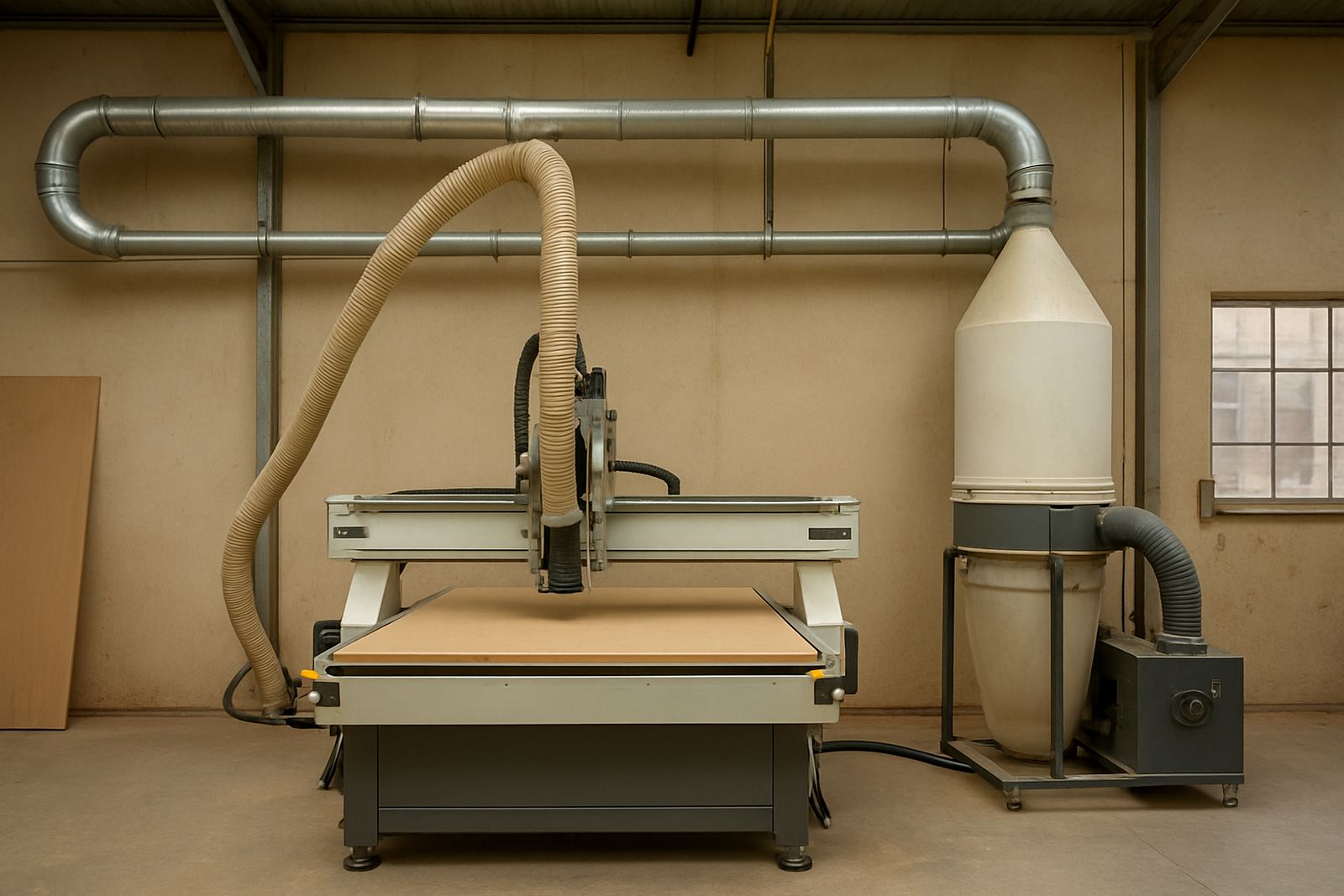
Start with the machine, then draw the route
Dust extraction works best when the duct plan follows the way the machine is actually used. Start at the router, mark the cutter area, then trace the shortest practical route to the extractor or dust collector. If the hose snakes around stored sheet material, benches or columns, air speed drops and chips settle in the line.
In many Johannesburg and Germiston workshops, floor space is tight and the machine has to sit near a wall or roller table. That does not mean the ducting should be an afterthought. Measure the route before any drilling starts, and check where doors open, where fork lift traffic passes and where operators stand during loading. A clean route is usually the one with the fewest turns and the least chance of damage.
Keep bends gentle and hose lengths sensible
Bends create resistance. Long flexible hose does the same, especially when it is sagging or partly crushed under a pallet or timber pack. Where possible, use rigid duct for the main run and keep flexible hose only where the machine needs movement. That gives the extractor a better chance of holding air speed at the cutter head.
For a single router in a small shop, a simple layout can often outperform a complicated one that tries to look neat on paper. Fewer bends, fewer joins and fewer sudden changes in size all help. If the extractor is on the other side of the room, plan a straight overhead run or a wall mounted route instead of dragging hose across the floor.
- Use the shortest safe route from machine to extractor.
- Avoid tight elbows where a broad sweep can be used.
- Do not let hose sag between supports.
- Keep the duct size consistent for as long as possible.
Match the layout to the material you cut
Different jobs put different demands on extraction. MDF and composite boards make fine dust that needs steady airflow. Plastics can create light, static prone chips that hang in bends. Soft metals need careful chip control so swarf does not build up around the cutter or table. Your duct layout must suit the worst case job, not just the easiest one.
If a workshop cuts nested furniture parts in the morning and signage panels in the afternoon, the duct plan should be able to cope with both. That means placing the main collection point where it can clear the table fast, while also giving the operator an easy way to clean the line after dusty runs. In coastal areas like Durban North and Cape Town North, humidity can also affect dust build up inside long runs, so access points matter more than people expect.
- Fine dust needs stable airflow at the nozzle.
- Plastic chips need open bends and easy clearing points.
- Soft metal swarf should not be allowed to sit in low spots.
- Humidity can make dust cling, so plan for cleaning access.
Allow for table options, tooling and operator access
The dust line should not block normal work around the machine. On many CNC routers the table, spoil board and vacuum zones all need space around them for loading, clamping and maintenance. If the duct drops across that area, operators will work around it and the hose will suffer. That leads to leaks, blocked filters and avoidable downtime.
It is also worth thinking about how the machine will be serviced. A layout that looks fine on installation day can become a problem when the spindle needs attention or the table has to be lifted. Keep enough clearance for the service team, and make sure unions, clamps and inspection points are reachable without moving the whole machine.
- Leave space for sheet loading and offloading.
- Keep ducting clear of service panels and moving parts.
- Plan inspection points near likely blockage areas.
- Allow room for future tooling changes and table changes.
Use the jobsite conditions to decide the final route
A good dust duct layout is never the same in every town. A workshop in Germiston may have a compact floor plan and a low roof, while a Pretoria East site might have more height but longer distances to the extractor. In Midrand, new industrial spaces often have open bays but shared services that make wall mounting tricky. The layout must suit the site, not a drawing pulled from somewhere else.
Power interruptions also matter. When load-shedding hits, a poorly supported hose can drop onto the floor and become a trip risk, or a loose join can open up when the system restarts. Simple brackets, clear labels and a route that keeps lines off walkways make the workshop easier to manage when the lights come back on.
At one Germiston installation, a small sign shop had an extractor that was strong enough on paper but underperforming in practice. The issue was not the machine, it was the duct route. Two sharp bends, one crushed flex section and a long low run were slowing everything down. Reworking the line into a shorter overhead path improved pickup at the cutter head and reduced daily cleaning time.
Build for maintenance, not just for day one
The best duct layouts are simple to inspect. If the team can see where dust collects, they can clear it before it becomes a blockage. That matters for small workshops that cannot afford long stoppages and for production cells that need predictable cycle times. Good planning makes preventive maintenance easier and keeps the operator focused on cutting, not fighting suction problems.
When MultiCAM helps a workshop with machine installation, commissioning or dust system balancing, the goal is to make the whole setup practical for the people using it every day. The layout should support the cutter, the extractor and the cleaning routine together. If those three parts work as one, the shop gets better extraction and fewer awkward hose runs.
- Use accessible joints and inspection points.
- Mark service areas clearly for the team.
- Keep spare clamps, seals and fittings on hand.
- Review the layout after the first few production weeks.