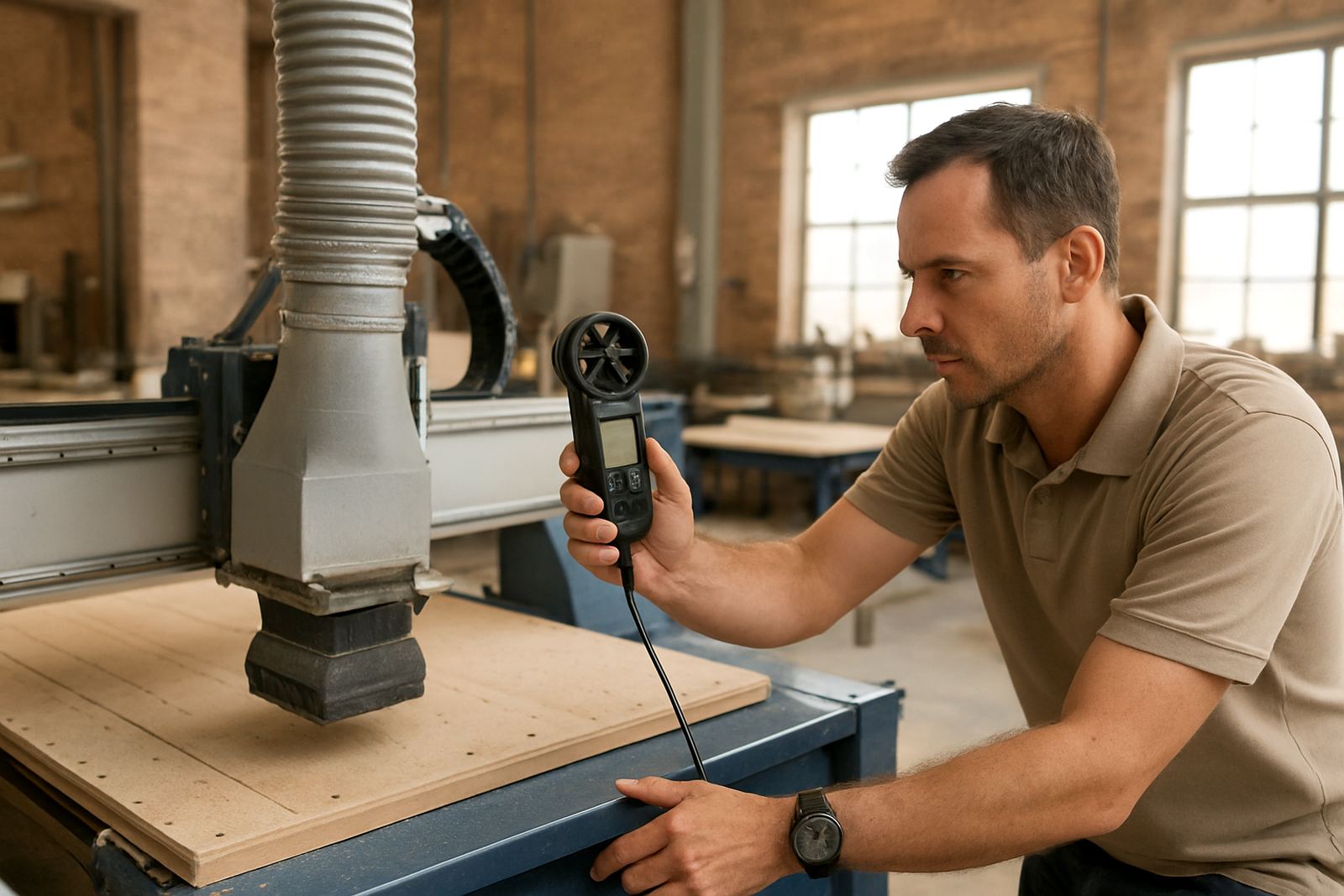
What dust system balancing covers in a CNC workshop
Dust system balancing is a site service for CNC routers, nested cutting tables and related workshop extraction lines. We check how much air is moving at each point, where losses are happening, and whether the machine is getting enough capture at the cutting area. In many workshops the extractor is doing work, but the airflow is not reaching the spoilboard or hood properly.
For wood, MDF, melamine, acrylic and soft aluminium work, poor balance can lead to chip build-up, dust returning into the cut, blocked filters and extra wear on spindles and rails. A balanced system also helps during load-shedding recovery, because uneven restart routines often leave gates, blast lines or collector settings out of sync.
- Airflow checks at the machine, duct runs and collector connection points
- Static pressure review to identify restrictive bends, undersized pipe or leaks
- Vacuum performance checks for table hold-down systems where fitted
- Dust hood, shoe and hose position adjustment for better capture
- Practical recommendations for daily use and maintenance intervals
How we test airflow, pressure and capture
Our process is practical and site-based. We start with the machine in the condition you normally use it, because a clean theoretical reading does not always match a busy workshop. The team checks the layout, duct diameter, branch runs, filter condition and whether multiple machines share the same extraction source. If a nesting router, edge work or hand cleanup area is tied into the same line, we look at how that affects available air.
Depending on the installation, we may measure airflow in cubic metres per hour and confirm static pressure in Pascals across the line. We also inspect gates, flex hose, blast valves and any quick changes that could be causing drop-off. On enclosed systems we look at table leakage and seals, since a vacuum table that leaks badly can starve dust capture elsewhere. Small faults like a split hose or loose clamp can waste a surprising amount of suction.
- Visual inspection of ducting, bends, filter housing and seals
- Airflow and pressure readings at key points in the system
- Leak and restriction checks on hoses, joints and access doors
- Balance adjustments for branch lines and machine pick-up points
What you receive after the balancing visit
After the visit, you receive clear feedback in plain language. We explain where the system is underperforming, what is safe to keep using, and what should be corrected first if you want better chip removal. Where the issue is mainly set-up, we can usually improve performance on the day by changing gates, hose routing or table settings. If the problem is mechanical, we will identify the parts that need attention before the collector can work properly.
The service is useful for new installations, older machines and moved equipment that has been reconnected in a different building. It also helps when workshops expand and add a second router or a manual extraction point. In Germiston and across Gauteng, we often see systems that were fitted for one machine but are now expected to support three or four work areas. That usually needs a proper rebalance, not just a stronger motor.
- Site findings with practical corrective notes
- Recommended changes to ducting, hoses or collector settings
- Advice on cleaning intervals and filter care
- Operator guidance for better daily dust control
Turnaround for Johannesburg, Gauteng and national sites
For Germiston, Johannesburg East, Midrand and Pretoria East, balancing visits can often be arranged quickly, subject to technician route planning and machine access. Regional work in Durban North and Cape Town North is scheduled with travel and site conditions in mind. If the machine must stay in production, we can plan the work around off-peak hours or after a shift change.
Typical site time depends on the system size. A single router line with one collector may take 2 to 4 hours. A larger workshop with shared ducting, more than one machine and a vacuum table can take half a day or more. If filters are badly loaded or the ductwork is damaged, the corrective work may need a follow-up visit. We try to keep disruption down, but proper testing takes time and rushing it gives poor results.
- Small single-machine sites: same day where possible
- Shared systems and production cells: planned half-day bookings
- Relocation follow-up: best done after final machine placement
- Urgent checks available for blocked lines or weak capture
Pricing approach for dust system balancing
Pricing is based on the site layout, number of machines, access time and whether the service needs travel beyond the Gauteng corridor. We quote after understanding the machine mix, collector size and what sort of correction is likely. A simple check on one router is not priced the same as a production cell with long duct runs, roof-mounted extraction and multiple blast gates.
We do not treat balancing as a quick once-off guess. It is a measured service, and the value comes from cleaner cuts, less downtime and reduced wear on consumables. If a workshop has repeated clogging or poor chip pickup, the cause is often hidden in the airflow path. Fixing that early usually costs less than replacing filters, belts or damaged tooling later.
- Quoted per site after machine and duct review
- Costs vary by access, travel and system complexity
- Best value when combined with maintenance or commissioning
Keeping the system in balance between services
Dust systems drift over time. Filters load up, hoses soften, gates get left in the wrong position and workshop changes add length to the line. In South African workshops, that can happen faster in coastal humidity or in dusty industrial areas where cleanup is constant. We normally recommend checking the system at set intervals so the extractor stays matched to the machine.
For most router workshops, a quick review every 6 months works well. Busy production sites, or sites cutting MDF and board all day, may need checks every 3 to 4 months. After machine relocation, duct modification, spindle service or a major table change, the airflow should be rechecked. If you notice finer dust sitting on the table, chips collecting around the tool path, or the extractor sounding different, that is usually a sign the system has shifted.
- 6-month checks for normal router use
- 3 to 4 month checks for high-volume cutting
- Immediate recheck after relocation or duct changes
- Filter and hose inspection at every maintenance visit
Key facts
| Typical airflow range | 2 500 to 8 000 m3/h depending on machine and duct size |
|---|---|
| Static pressure check | Measured in Pascals across collector and branch lines |
| Common duct sizes | 150 mm, 200 mm and 250 mm workshop runs |
| Service time | 2 to 4 hours for a single router, longer for shared systems |
| Review interval | In MDF and chipboard routing, schedule this about every 3 to 6 months, depending on workload |
| Coverage area | Germiston base with installs and service across South Africa |